Pages

Sunday, July 29, 2012

Can-Do's/Can't-Do's

Lately, some of my friends have been having a tough time remembering what they Can-Do when they're upset or angry. Often times my friends use unsafe words and actions which are on the definite Can't-Do list. After seeing my supervisor work with one friend on this very issue, I decided to work with a couple of friends in my other groups.

So far I have worked with one friend and it was a great teachable moment. A different friend provoked him and my friend wanted to retaliate. I was there and able to steer him towards the break room, tears and all. After some cool-down time, and food, he was ready to chat. I spent time with him in the quiet space working through an anger thermometer followed by a list of his Can-Do's/Can't-Do's.

He did such a great job identifying situations that make him feel the varying degrees of anger, which provided some interesting insight. He did need some prompting and scaffolding to identify which strategies went on which list. For example, his go to of physical contact with someone was a definite Can't-Do and he needed that reminder. Instead, he could squeeze putty or a squeeze ball. (He liked the idea of making his own squeeze ball too.)

When his counselors went over his daily note he identified that "When [he] thought about [his] goals, [he] liked that [he] worked on calm down strategies in the quiet space."

Be still my heart! I haven't heard sweeter words all summer!

I'll hope for similar results from my next friend and hope to see this friend using some strategies we discussed. *fingers crossed!*

Until next thyme,
Erika

Sunday, July 22, 2012

Sharing the Conversation Space

Thanks to Pinterest I found yet another Social Thinking theme to have with one of my groups this past week. This week I focused on sharing the conversation space. This group has more than its fair share of Chatty Cathy's and the counselors found it difficult to manage. In any given moment they could have two kiddos vying for their attention. 

I decided to show a short video to serve as an introduction to sharing the conversation space. In the video two boys are having a conversation about dogs. One boy dominates the conversation and does not give the other a chance to comment. The next segment provides the internal monologue of each boy, indicating what they were thinking and feeling. I had my group predict how each boy might have felt before we watched this segment. The final segment is a sort of 're-do' of the conversation in which both boys use their social thinking skills to allow each other ample "Air Time." The group was engaged throughout this video and I will definitely remember that as I plan for future sessions.


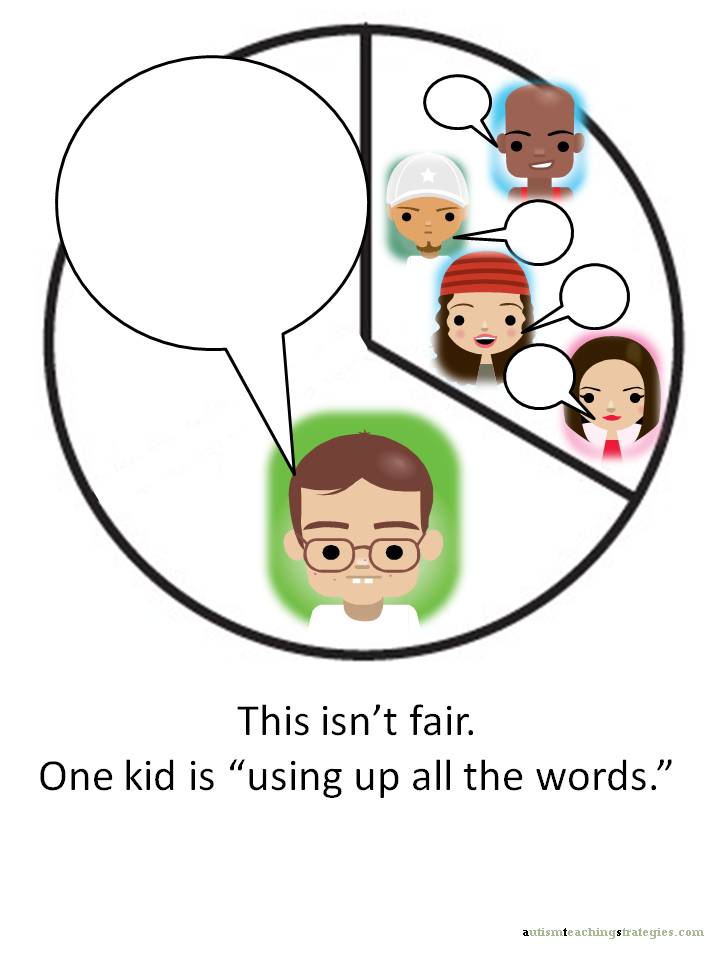
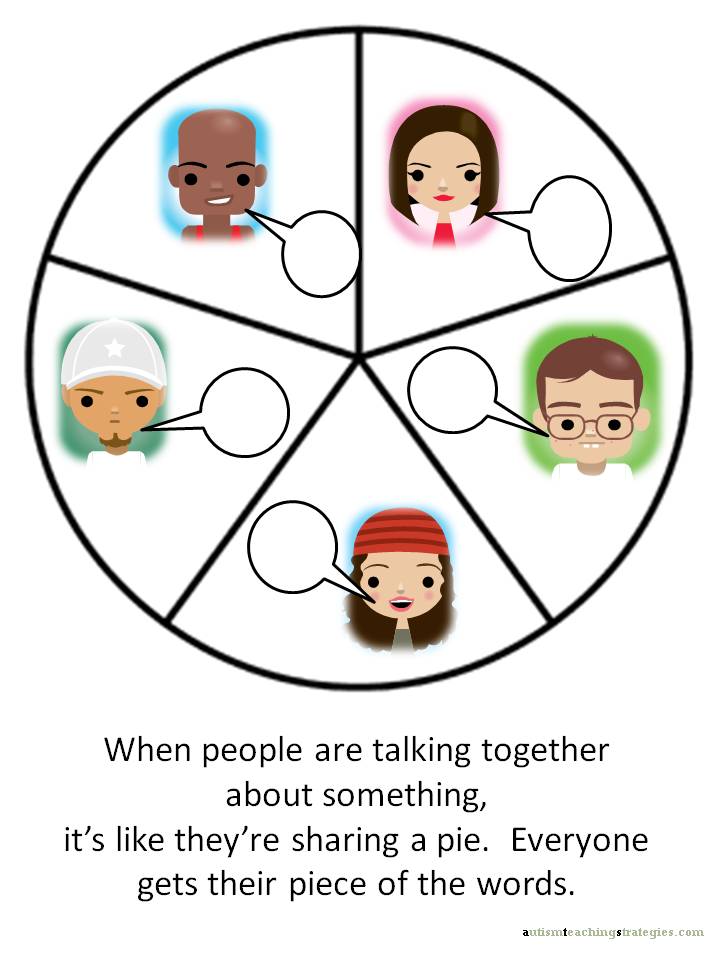
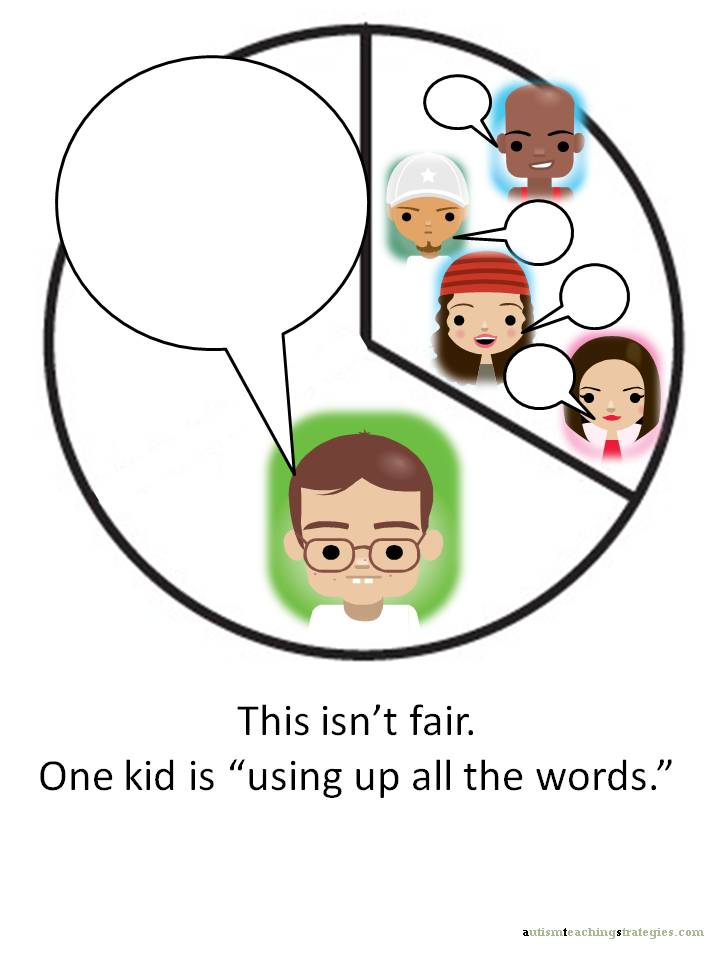
The second half of group was spent thinking about conversations in terms of a pie or pizza. It is important to provide everyone with equal "Air Time" in the group. I had a coloring worksheet for the kiddos to fill out that was pre-divided for the number of group members. We also discussed how counselors and other grown-ups can sometimes we "Air Hogs." In this discussion we talked about how often times counselors are given directions, trying to be helpful, or keeping you safe. One camper decided to draw the conversation space for his mother and he. Let's just say his perception of how much "Air Time" his mom got was interesting. However, working on that perception is another lesson for another day ;) !
http://autismteachingstrategies.com/wp-content/uploads/2012/03/Pie-chart-Slide-2-corrected2.jpg
http://autismteachingstrategies.com/wp-content/uploads/2012/03/Pie-chart-1.jpg


The counselors were impressed as to how engaged the group members were during the activities. I provided them with the visuals of sharing the conversation space and being an "Air Hog" to use as reminders throughout the summer. Previously, in their Morning Meetings, the group had made personal "Give Me 5" visuals for each camper as well as a speaker card. This was in an effort to use speaking and listening visuals as a reminder when one feels the need to interrupt or interject. 

Until next thyme,
Erika

P.S. Don't forget to follow me on Pinterest for even more ideas!

Sunday, July 8, 2012

Social Detective

Thanks to Pinterest I have found so many great resources to use during internship (and beyond), decorate my home (that I don't have), recipes to cook (when I have free time), and cute animals (to "ooh" and "ahh" over).

It has also been essential in preparing for summer camp! A coworker suggested we start a group board since we were all re-pinning the same resources again and again. Thanks to this great feature we have been able to pool our efforts and create a pretty decent array of games, projects, and varying resources to help our population (children who have Autism/Aspergers).

At camp this summer I serve as the Assistant Site Director (ASD). In this role I supervise three groups aged 5 to 9, which includes 13 campers (as of now) and 6 staff members. Also run a social thinking group for two of the groups. There is an additional ASD who works with the 10 to 14 year old at camp. All of these kids are based out of Boston while a second site is based out of a suburb 40 minutes outside Boston at a Reservation. For more info on the camp check out the website.

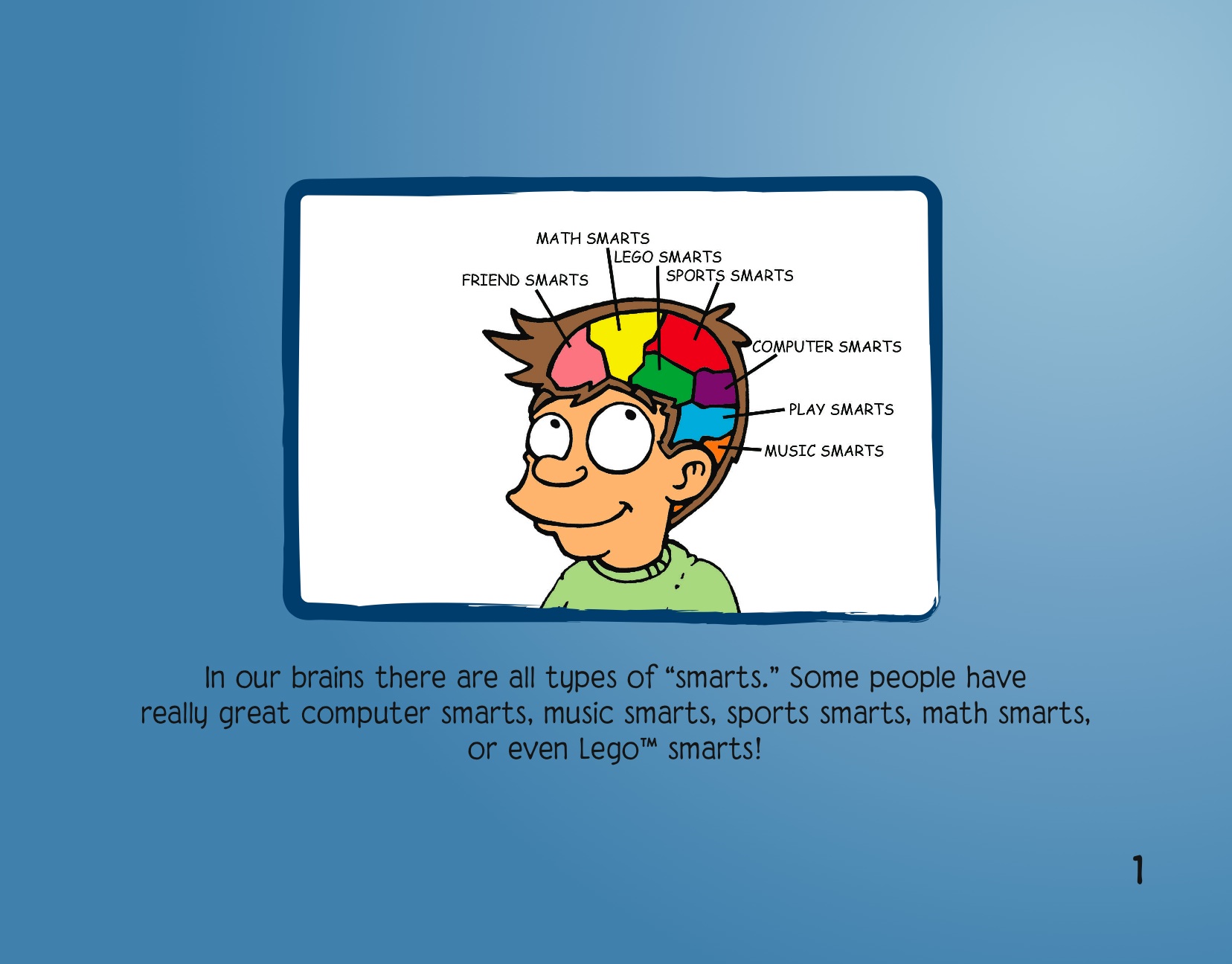
In the first week of camp my Site Director/Supervisor suggested using Michelle Garcia Winner's book You're a Social Detective as a way to introduce expected and unexpected behaviors. For my first group of campers (7-8 years) we read the first section of the book on expected behavior. We then did a coloring activity to identify their different types of smarts (including Social Smarts!). The kids (and adults) found it tricky but everyone came up with some great smarts.


For my second social thinking group of the week (aged 8-9 years) worked on the same topic with a different spin. The group also listened to the book but worked on both expected AND unexpected behaviors. Following the read aloud the group took part in a scavenger hunt I found along my Pinterest browsing. Campers searched for clues that forced them to identify whether the behavior was expected or unexpected. Based on their response they were led to the next clue. The campers LOVED this activity and demonstrated some great turn-taking and teamwork skills. The activity can be found here.

I'll be brainstorming some ideas for next week's groups and tailoring it to the needs of the group (e.g., whole body listening, safety, etc). Thanks to Pinterest this may be easier than I think :)

Be sure to follow me for resources that will (hopefully) make your group planning that much easier.

Until next thyme,
Erika