Pages

Showing posts with label #schoolpsychology. Show all posts

Tuesday, May 21, 2013

Summer of Erika


Anyone a fan of Seinfeld in the audience? I grew up watching the show every night on re-runs with my dad and brother. I can recite most episodes and have probably seen them all at least three times. Well, as summer approaches and the employment hunt underway, I have been struggling to figure out what I’ll do with my summer. I have been torn about getting a summer job as I have had for the past seven years or to take it off in hopes that I’ll have so many interviews I wouldn't be able to hold a job down (or the third option, and most preferred, which is get hired by my current district by the end of the school year and spend my summer doing what I want ‘cause I’m employed with an actual salary).

While I am uncomfortable not working in fear that I won’t find a job (which is false) and will have student loan payments out my eyeballs (truth), I have really been procrastinating finding something to occupy my summer, even part-time. In the end, it looks like I’ll be having a Summer of Erika (insert Seinfeld reference here).
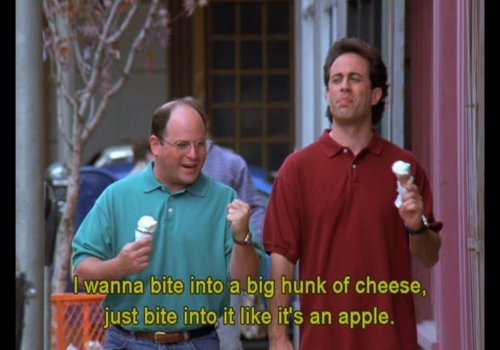
Yes. Yes, I do.
So, what will I be doing with a Summer of Erika? I've been dreaming of this all year as I don’t think I ever really intended on working (but feel super guilty about not). I've managed to compile a list of things I hope to accomplish, both leisure and professional activities. These are things I’ll be doing on my own, for me. I also make a wish list of summer adventures for me and the boy. Can you tell that I’m Type A?

  • Read. Read professional books and read some leisure books. Learn to juggle the two at once. Preferably on the beach.

  • Get Crafty I. Make some of those beautiful projects I find on Pinterest. Put some of my favorite quotes on canvas for my office.

  • Get Crafty II. Make coasters for the apartment.

  • Plan. Plan for my first year as a school psychologist. Review Dr. Branstetter’s book. Develop some lesson plans for groups I think I might be able to run given the population of students (i.e., elementary = social skills).

  • Sort. Sort through some of my pins from Pinterest and pick the ones I want to try and use.

  • Educate. Review some of the webinars I have found. Setting a goal of one per week, or eight total.
Now, I am VERY well aware I am going to be bored out of my mind. I mean, who am I kidding; I had cabin fever by hour 36 on all my hurricane/snow day stretches this year. I’m trying to think of this as a time to really psych myself up for the next year. I’ll already be happy to go back to work, but add boredom to the mix and I’ll be super-psyched to be there (play clip here…can you name the movie?)

http://www.youtube.com/watch?v=qOga3VZ5CGY
In a final attempt to justify my Summer of Erika, I have done some calculations. My district gets out June 28 and a typical school year begins August 26 (for PD). That gives me exactly eight weeks to do as a wish. I figure that I’ll have one week of bliss, a few day/weekend trips to plan and go to, and I have two weddings in August. So really I’m looking at 4.5 weeks of “nothing” to do and time to accomplish my summer wish list.

I think I’m going to be just fineeee. 

What are your summer plans? Working? Relaxing? Recent grads treating yourself to a fun vacation (if so, I’m super jealous)? Any additions to my own list? Any ideas of places to go with AC (so I don't rack up my own electric bill?)

Until next thyme,
Erika

P.S. Here are some funny comics I found to get us ready for summer vacation! The last one is my favorite.

For my Tweeps!

Right now, I just get July and Aug...the "-ust" is under contract


Wednesday, May 15, 2013

School Psychology Portfolio Guide


Portfolio. The dreaded word to those in graduate school for those in school psychology, as well as many others in the world of education.

When I went for my interview at my program there were different portfolios on display. Each had their own creative twist as to how the student presented themselves as a graduate student of school psychology. The contents ranged from reports to progress monitoring data to information about their school placement. This evidence was developed as part of the field placement experience and coursework that was being done by students. Eh, not so scary, right?

WRONG. Wrong, wrong, wrongity, wrong!

My portfolio has been my largest struggle (and bane of my existence) during my grad school career. (There I said it! ::gasp::)


Some domains are easier than others to find evidence for, like data-based decision-making (DBDM). This informs each and every facet of our work as school psychologists. However, it is important to decide whether or not something belongs in DBDM or another domain; it is all about best fit. One domain I am always coming up short is Interventions and Instructional Support to Develop Academic Skills. You would think that that in the age of Response to Intervention this would be easy. Nope, not at the secondary level, which is where I have spent the past two years. In a mad dash to put something together I read a book (RtI: Success in Secondary Schools by Jim Wright), did some observations, and wrote up a “quick” reflection paper (hours and hours later). Even though the portfolio is finished, this is still something I am pursuing. I know this is an area of weakness, which is one reason why the portfolio exists (to help us identify areas that need continued development).

During the first two years of training it can be difficult to put things in each domain. You end up being a sucker for blank protocols or hypothetical case studies (i.e., if presented with X, I would do Y). Thinking back on what my portfolio used to look like, I’m appalled as I can’t imagine throwing in protocols for fun! However, in those first years your portfolio won’t look like an intern’s. It is not supposed to. The portfolio demonstrates the growth you’ve made over time. (Not to mention the elation you feel when you can take something out you hate because you have an actual piece of evidence to put in its place!).

One of my largest criticisms was the transition from eleven to ten domains between my first and second year of grad school. As a result I needed to reorganize all of the domains and find new places to put things. It was more of an organizational pain than content, especially since I began my portfolio as a hard copy with lots and lots of papers to print. But I digress….

So, what is the best way to approach the portfolio? Well, some people recommend beginning it after your first year, but other programs may require it to be developed during your first year (mine did). I didn’t have much to show, but it was still satisfying to have something to present my hard work in.  

In the age of technology, I would highly recommend going electronic. I was annoyed with this notion at the start of my internship, but have grown to love it. I spent some time at the end of the summer and early year developing my website. There a bunch of places you can make a free website. I used Weebly. You can also try Google Sites. I found Weebly user friendly, easy to navigate, and with enough features to make my portfolio look professional, including file upload and photos.


As you can see above, I have a number of pages along the side bar for visitors to navigate. I included an about me page, a separate page for each domain, and a place for my field log. I also included a professional development list, assessment measure list, and a contact option. You can truly customize this site however you want to best suit your needs.

My program required us to write a reflection of our experiences and goals on each domain. When you approach a page you will find NASP’s description, my reflection, and my evidence of competency. I chose at least one solid piece of evidence from my internship year and a second if it was relevant and exquisite. The only exception was the Research and Program Evaluation where I used my first year research project. Each piece of evidence is able to be downloaded as a PDF, which I have also watermarked for my own protection.


By developing an online portfolio you can easily upload all of your documents and it goes live in real time (as soon as you hit publish). I have included my website address on my resume to go with my applications. I know that if someone took the time to look at the portfolio they would get a true sense my skill set rather than how I appear on paper in my resume. For this very reason, I chose to include my photo. Seeing my face as a potential candidate, and placing it with my experience, will (hopefully) make me stand out and be memorable.

I also plan to use it in my interviews (when they start rolling in). I own a tablet, so I will be able to refer to my work found on the portfolio. Electronic access to writing samples doesn’t hurt either.

If you want to take a look, my portfolio can be found here.

My few pieces of advice for those just starting out or looking to revamp their portfolio:

  1. Go digital. It won’t take very long to develop the online site. Figure a few hours on a weekend, with plenty of opportunities to tweak as you go. Also, no one wants to see you lug in your gigantor binder into your interview.

  2. Start Early. Start Small. Begin this summer if you can. Take what you already have developed, or plan to develop, and start designing. You don’t have to go live immediately and can instead save it until you’re ready for the big reveal. Don’t go too big either. Start basic and add along the way. It doesn’t need to be so sophisticated, especially when you are just starting out in your program or career.
  1. Update. Update. Update! You have the ability to constantly update your portfolio and add things as you go. Being online things are much simpler and more eco-friendly. Be sure to update post-graduation, especially if it is online. People will have the ability to find you through search engines. If you are switching positions after a few years it would also be helpful to include more current work samples. Uploading as you go is much easier than saving it for later. (Let’s see if I can follow that advice!).
  1. Personalize it. Make it personal. The point of the portfolio is to give a sense of who you are as a person, as well as a school psychologist. On my “About Me” page I included some hobbies and photos to add a personal touch. Giving a glimpse into my life outside of school psychology makes me more approachable and real (in my own opinion).

I hope this is helpful as you are developing your portfolio or thinking about your portfolio. Digitalizing it is a great way to set yourself apart, as well as demonstrate that you are able to be tech savvy as our position involves more and more computer use.

If you have any comments or questions feel free to leave them here or through my contact page on my portfolio.

Until next thyme,

Erika